


Why HEPA Filter Replacement Needs a Safety Plan
HEPA filters are designed to capture fine particles. That is their job. But once the filter has been operating for months or years, the captured material becomes the main safety concern.
•A used HEPA filter may contain:
•Biological particles from healthcare or laboratory exhaust
•Pharmaceutical powder or API residue
•Mold spores or contaminated dust
•Chemical particulates
•Process dust from industrial production
•General high-load particulate buildup
In healthcare environments, OSHA defines regulated waste to include certain contaminated items that may release blood or other potentially infectious material during handling, as well as pathological and microbiological wastes containing such material. That is why the facility's EHS team should classify the used filter before removal, not after it is already on the floor.
Key point: the risk is not only the filter media. It is also the dust released during loosening, pulling, bagging, transport, and disposal.
When a Bag-In Bag-Out System Is Needed
A bag-in bag-out system is a filter housing design that allows maintenance personnel to remove and replace contaminated filters through a sealed bag attached to the housing access port.
It is commonly used in:
•Hospital isolation exhaust systems
•Infectious disease laboratories
•Pharmaceutical exhaust systems
•Animal research facilities
•Nuclear, chemical, or toxic dust applications
•High-containment cleanroom exhaust
•BSL-related ventilation systems
•Hazardous process exhaust lines
IEST-RP-CC034 covers leak testing of HEPA and ULPA filters at the factory, job site, and after installation in cleanrooms and clean-air devices, which is why BIBO replacement should be planned together with post-installation verification instead of treated as a separate maintenance task.
A standard front-access HEPA box may be acceptable for normal HVAC supply air. It is not always appropriate for contaminated exhaust.
Our engineers often see the same mistake: the buyer specifies H14 filtration but forgets to specify safe replacement access. The filter may perform well, but the maintenance process becomes unsafe and expensive.
Recommended PPE Before HEPA Filter Removal
The exact PPE must be defined by the facility's EHS team, the contaminant type, and local safety rules. Still, for high-risk HEPA replacement, the maintenance team commonly prepares:
•Disposable protective coverall or gown
•Double gloves
•Safety goggles or face shield
•Respirator selected by risk assessment
•Shoe covers or dedicated safety footwear
•Cut-resistant gloves if handling metal frames or sharp edges
•Biohazard or hazardous waste bags where required
•Approved disinfectant or decontamination material
•Labels, tape, cable ties, and secondary containment
For healthcare, laboratory, and biological-risk areas, do not assume a used HEPA filter can be handled as normal solid waste. EPA notes that medical waste is primarily regulated by state environmental and health departments in the U.S., so facilities should check their state and local rules before disposal.
PPE is not the whole safety plan. Airflow isolation, containment bagging, labeling, and waste routing matter just as much.
Bag-In Bag-Out HEPA Filter Replacement: Practical Step-by-Step Process
The exact procedure should follow the equipment manufacturer's manual and site SOP. The sequence below shows how many controlled replacement projects are organized.
Step 1: Review the Filter Use History
Before opening the housing, confirm what the filter has been exposed to.
Check:
•Application area
•Supply air or exhaust air use
•Biological, chemical, or pharmaceutical exposure
•Operating hours
•Pressure drop trend
•Last leak test report
•Previous maintenance records
•Required shutdown permits
•Disposal classification
This step prevents a dangerous assumption.
A HEPA filter from a normal AHU supply system and a HEPA filter from a hospital isolation exhaust line should not be treated the same way.
Step 2: Shut Down or Stabilize the System Safely
•Depending on the system design, the team may need to:
•Shut down the fan
•Close isolation dampers
•Confirm negative pressure where required
•Lock out and tag out electrical power
•Prevent backflow
•Post warning signage
•Restrict access around the work area
Do not open a contaminated HEPA housing while the system is in an uncontrolled operating state.
For some exhaust systems, airflow conditions must be carefully managed so contaminants do not escape toward the technician or the room.
Step 3: Inspect the BIBO Housing and Bag
Before touching the used filter, check the housing.
Look for:
•Damaged bag ring
•Torn or aged PVC bag
•Loose straps
•Damaged gasket
•Corrosion around the access door
•Missing safety clips
•Sharp edges that may puncture the bag
•Incorrect replacement bag size
A BIBO system only works when the bag, clamping ring, and housing door are in good condition.
If the bag is brittle, cracked, or poorly sealed, stop and replace the bag before proceeding.
Step 4: Attach and Secure the Replacement Bag
The replacement bag should be fixed tightly to the housing ring before the access door is opened.
Typical checks include:
•Bag fully seated around the access port
•Retaining strap or clamp tightened
•Bag material not twisted
•Enough bag length for filter removal
•Labels prepared before the filter is pulled
•Secondary bag ready if double-bagging is required
This is the "bag-out" side of the process. The used filter should never be exposed directly to the room.
Step 5: Pull the Used HEPA Filter Into the Bag
The technician loosens the filter clamping mechanism and carefully pulls the used HEPA filter into the sealed bag.
During removal:
•Move slowly
•Avoid shaking the filter
•Do not hit the media pack
•Do not compress the filter
•Keep the filter frame stable
•Keep the contaminated side contained
•Do not cut or tear the bag
The goal is simple: remove the used filter without releasing captured contaminants.
Step 6: Seal and Separate the Used Filter Bag
Once the filter is inside the bag, the bag is sealed between the used filter and the housing port.
Common sealing methods may include:
•Heat sealing
•Cable ties
•Clamps
•Tape plus mechanical ties
•Double-bagging when required
The sealed used filter is then separated from the housing side.
For contaminated medical or biological applications, the bag should be labeled according to facility policy and local regulation.
Step 7: Bag In the New HEPA Filter
The new filter is introduced through a clean replacement bag or through the BIBO housing method specified by the manufacturer.
Before installation, check:
•Correct filter size
•Correct efficiency grade
•Correct gasket or gel seal type
•Airflow direction arrow
•No visible media damage
•No frame deformation
•Factory test label or certificate
•Correct batch number and model number
For high-grade filters, do not accept crushed pleats, damaged separators, cracked gasket material, or twisted frames.
A small installation defect can become a leak point.
Step 8: Seat the Filter and Tighten the Clamp System
Install the new HEPA filter into the housing and tighten the clamping system evenly.
Check:
•Gasket compression
•Filter alignment
•Knife-edge position for gel seal filters
•No bypass gap around the frame
•Door gasket condition
•Access door tightness
•Pressure tap connection
•Housing integrity
•Uneven clamping is one of the most common causes of field leakage.
Our engineers often see buyers blame the HEPA filter when the real issue is a warped housing, weak clamping pressure, or a damaged gasket surface.
Step 9: Restart and Check Pressure Drop
After installation, restart the system according to the site procedure.
Record:
•Initial resistance
•Air volume
•Differential pressure
•Fan speed
•System operating condition
•Filter model and serial number
•Installation date
The initial resistance should be compared with the design value and the filter datasheet.
If the pressure drop is much higher than expected, check airflow volume, installation direction, pre-filter condition, and duct resistance before assuming the filter is defective.
How to Handle HEPA Disposal in Medical or Biological ApplicationsProducts Description
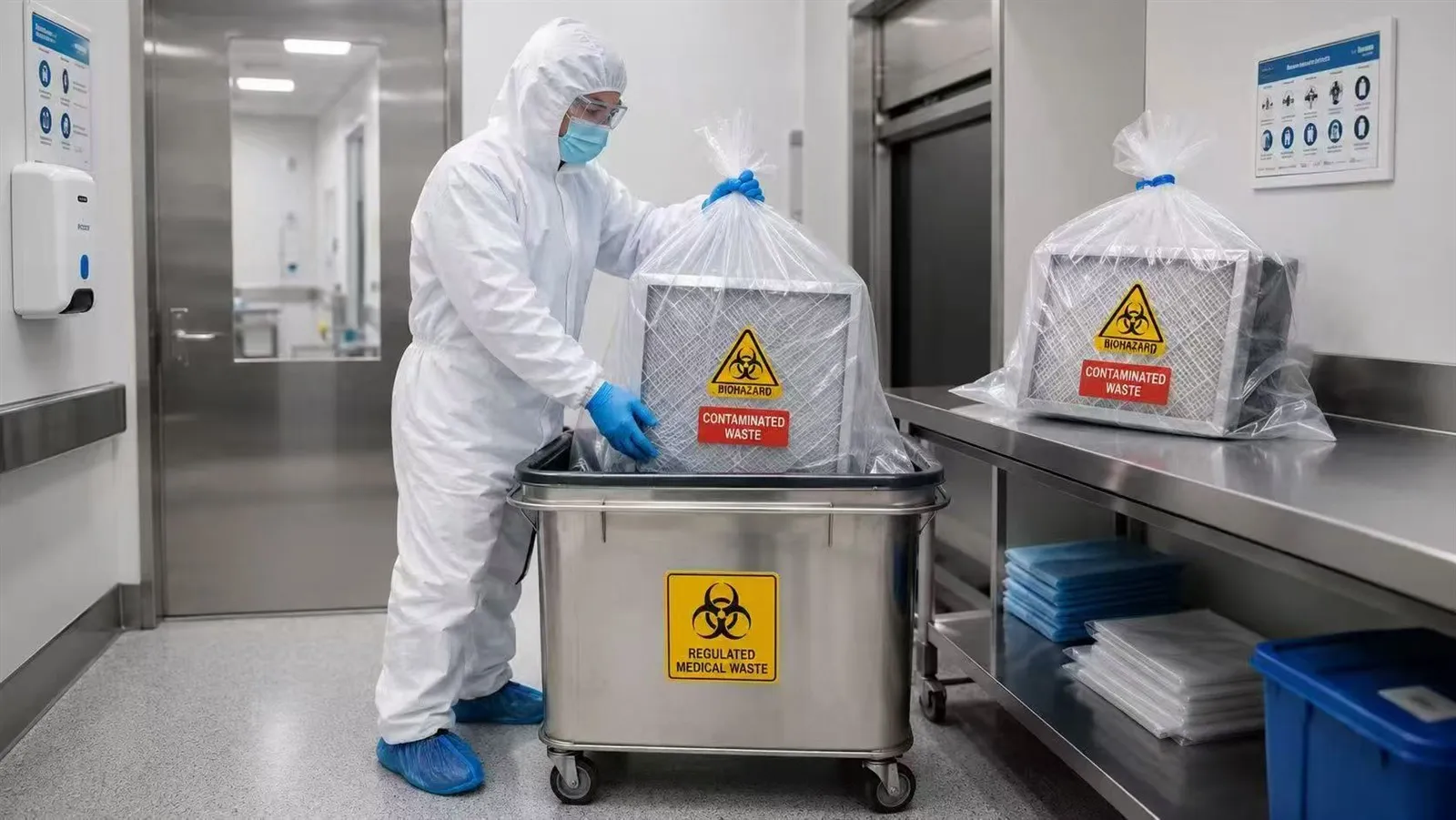
HEPA disposal depends on what the filter captured during operation.
A used HEPA filter from a commercial office AHU may be disposed of through normal industrial waste channels, depending on local rules. A used HEPA filter from a medical isolation exhaust system may require regulated medical waste handling.
CDC guidance on regulated medical waste focuses on waste that may contain infectious materials, while EPA states that medical waste disposal requirements in the U.S. are mainly handled by state environmental and health departments. In other words, there is no single disposal rule that fits every hospital, lab, or country.
Practical Disposal Recommendations
For medical, laboratory, or biological-risk HEPA filters:
•Classify the filter before replacement
•Keep the filter sealed after removal
•Do not reopen the bag for inspection
•Use labeled biohazard or regulated waste packaging where required
•Follow facility EHS procedures
•Use approved waste contractors
•Keep disposal records
•Confirm whether treatment is required before final disposal
Possible treatment routes may include:
•Autoclaving where suitable
•Incineration through approved facilities
•Chemical decontamination where allowed
•Special hazardous waste handling if chemical residue is present
If the filter has chemical, cytotoxic, radioactive, or mixed contamination, do not treat it as standard medical waste. The disposal route must match the highest-risk contaminant.
Do not guess. Misclassification can create legal, safety, and environmental problems.
DOP / PAO Leak Test After HEPA Replacement: What Should Be Verified
A proper field test should check more than the filter face.
The Technician Should Verify:
•Upstream aerosol challenge concentration
•Downstream scanning of the filter face
•Filter gasket or gel seal area
•Housing frame joints
•Probe scan speed
•Test aerosol type
•Acceptance criteria
•Repair method if a leak is found
•Retest result after repair
•Final written report
In situ HEPA filter bank testing is commonly done by introducing aerosol upstream of the filter and scanning the downstream side of the filter and support frame; this checks installation integrity, not just factory filter efficiency.
Factory test reports are important, but they do not replace field leak testing after installation. Transport, handling, clamping, and housing condition can all affect the final seal.
Common Mistakes During HEPA Filter Replacement
Mistake 1: Replacing the Filter Without Knowing the Contamination Risk
A maintenance team may see only a metal frame and filter media. They may not know what the filter captured.
Before replacement, check the process history.
Mistake 2: Using a Normal Filter Box for Contaminated Exhaust
Standard access doors may expose workers to contaminants during removal.
For hazardous exhaust, specify a bag-in bag-out system from the start.
Mistake 3: Touching or Compressing the Used Filter Media
Used HEPA media can release particles if shaken, cut, dropped, or compressed.
Handle the filter by the frame only.
Mistake 4: Skipping the Gasket Check
A new HEPA filter can leak if the gasket is twisted, over-compressed, under-compressed, or installed against an uneven sealing surface.
The gasket is small. The problem can be big.
Mistake 5: Treating Factory Certification as Final System Validation
Factory test reports confirm filter manufacturing quality. They do not prove the installed system is leak-free.
After replacement, perform field integrity testing when required.